Why Donabe Crack — and the Seasoning Step Most Overseas Guides Get Wrong
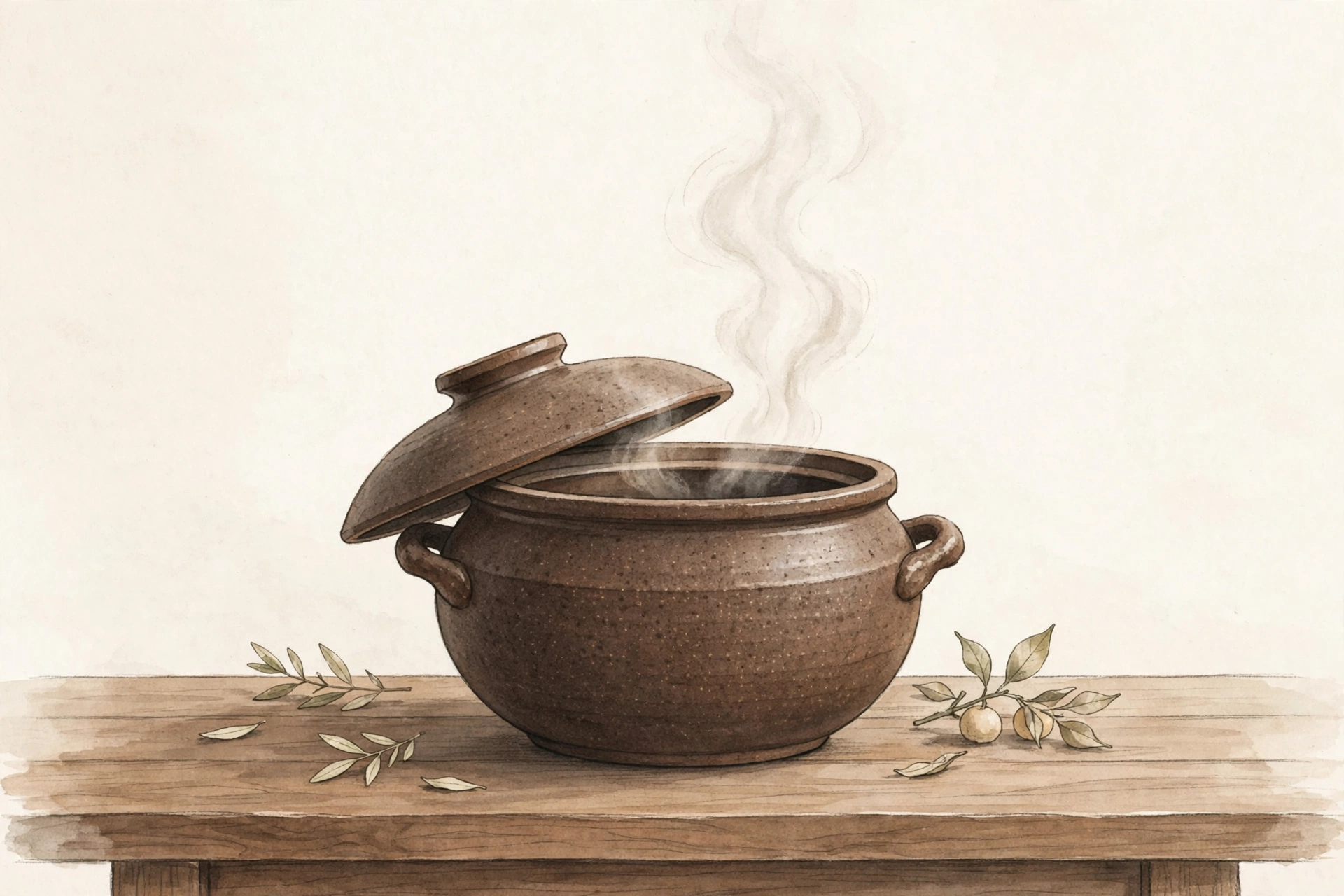
A donabe (土鍋) is the most rewarding pot in a Japanese kitchen — and the easiest to break on the first day.
It is not a defect in the pot. Almost every cracked donabe fails for one of two avoidable reasons: it was never sealed before its first real use, or it was hit with a sudden temperature change. Both are avoidable, and both are exactly what most overseas buying guides gloss over in a sentence.
This guide is written from Japan, from the makers' own instructions. Iga clay and Banko clay do not season the same way, and the English guides that contradict each other are usually quoting different makers without saying so.
Disclosure: this article contains affiliate links. If you buy through them, I may earn a commission at no extra cost to you. Prices were checked in November 2026 and change — check the store page before you buy.
The 30-second answer
- Season it before you cook in it. Cook thin rice porridge in the new pot (目止め, medome). It takes about an hour, mostly hands-off.
- Never heat it empty, and never blast it from cold. Start low, raise the heat gradually.
- Dry the base completely before it touches the flame. Water on the outside of hot clay flashes to steam — and steam is what splits the pot.
- Buy the right clay for the right job. Iga for rice and slow, heat-holding cooking; Banko for the everyday family hot pot.
- Check your hob first. An ordinary donabe does not work on induction. You need an IH-compatible model, a gas hob, or a portable gas burner.
If you only remember one thing: seal it, heat it slowly, dry the base.
Why porous clay behaves differently
A donabe is fired at a relatively low temperature from coarse, porous clay. That porosity is the point: the clay absorbs moisture and releases it as steam during cooking, which is why food comes out softer and more evenly cooked, and why a donabe brought to the table keeps simmering for twenty minutes with no heat under it.
The cost is that the clay body drinks water. Water sitting inside the wall of the pot turns to steam when heated, and steam needs far more room than water. If that expansion happens fast, in a body with no give, the pot splits.
That is the mechanism behind nearly every cracked donabe — and it explains why the two rules that matter most are "seal it" and "heat it slowly."
Fine surface crazing in the glaze is normal. A crack that leaks is not.
Medome: the step most people skip
Medome (目止め) literally means "closing the eyes" — sealing the pores. You cook a thin rice porridge in the new pot so that gelatinised starch penetrates and fills the micro-pores in the clay, forming a seal that keeps water from soaking into the body.
Do this before the first meal:
- Wash and dry the new pot. Rinse with water only, no detergent, and let it dry completely. The base must be bone dry.
- Fill it 70–80% with water. Never to the brim; the porridge will expand.
- Add starch. Roughly a cup of cooked leftover rice, or 2–3 tablespoons of raw rice, or 2 tablespoons of potato starch stirred in until dispersed.
- Heat slowly on the lowest setting. Bring it up gradually to a bare simmer. Do not rush this — the first heating of a new pot is when it is most vulnerable.
- Simmer 30–60 minutes, stirring now and then so the starch does not catch on the base.
- Turn off the heat and leave it alone until completely cool. Several hours, or overnight, with the porridge still in the pot. The slow cooling is doing as much work as the simmering.
- Discard the porridge, wash with water only, and air-dry thoroughly — a full day, upside down or on its side, before you cook in it.
Repeat medome every few months with heavy use, and any time you notice water soaking into the outside more readily than it used to. If a fine hairline appears, a medome cycle will often seal it before it becomes a real crack.
The one detail English guides get wrong
Nagatani-en, the Iga kiln behind the Kamado-san, insists on cooked rice for medome on its coarse Iga clay. Some Banko makers allow potato starch. English guides contradict each other on this because they are quoting different makers' sheets without naming them.
The rule is simple: if your pot came with a maker's leaflet, follow that leaflet first. The steps above are the general method; the leaflet is the authority for your pot.
The thermal-shock rules (non-negotiable)
| Rule | Why |
|---|---|
| Dry the base completely before it touches heat | Water on unglazed clay flashes to steam against the burner |
| Start on low and raise gradually | A cold pot on a high flame heats unevenly and splits |
| Never heat it empty or nearly empty | The most common way donabe die |
| Never add cold liquid to a hot pot | Same failure mode in reverse |
| Never put a hot pot on a cold, wet or metal surface | Use a wooden or woven trivet |
| Wash with a soft sponge and minimal detergent | Porous clay absorbs soap; never soak it |
| Store with the lid off, or paper between lid and rim | Trapped moisture grows mould |
Iga vs Banko: which clay, which pot?
Both traditions come from Mie Prefecture, but they are different clays for different jobs.
Iga-yaki (伊賀焼) — the premium, porous clay - Made in Iga since 1832; Nagatani-en is the best-known kiln. - High in organic matter, fired at a lower temperature, leaving it more porous. It absorbs moisture and releases it as steam — gentler, more moist cooking, and it withstands direct flame better than smoother clays. - Best for: rice, and slow cooking where heat retention matters.
Banko-yaki (萬古焼) — the everyday workhorse - Made in Yokkaichi; petalite was added to the clay from around 1959 to improve heat resistance. Roughly 80% of donabe in Japan are Banko ware. - Thinner-walled and lighter than Iga, with more precise temperature control. - Best for: the family hot pot you use every week.
What to buy: three picks, by job
Prices below are the ranges found in November 2026 from US retailers and Japanese guides — re-check before publishing, and replace Product link — to be added with the affiliate link after registration.
1. Best for rice: Nagatani-en Kamado-san — $110–180
Product link — to be added
The most famous donabe in the world, from a kiln founded in 1832. A double-lid system and thick Iga clay walls produce rice no electric cooker matches — plump, glossy grains, and if you leave it a minute longer, the prized crispy okoge crust at the bottom. The 3-gō size suits a couple; the 5-gō feeds a family. This is the heirloom buy. Season it exactly as Nagatani-en's leaflet says — cooked rice, not raw.
2. Best family hot pot: Ginpo Hana Mishima (Banko) — $40–80
Product link — to be added
The stamped-flower pattern is Japan's standard hot pot for decades. Petalite-rich Banko clay, lighter to lift to the table, and forgiving for a first donabe. Sizes run from a personal 6-gō to a party 10-gō; for most households the 9-gō (27 cm, serves 3–4) is the sweet spot. If you buy one donabe and you mostly cook nabe, buy this one.
3. Best first donabe on a budget: Mino ware donabe — $40–70
Product link — to be added
For a first pot or occasional use, a well-made Mino ware donabe is the practical starting point. Same medome, same thermal-shock rules — the clay is less romantic, the price is not.
What not to buy by mistake: an ordinary donabe if you only have an induction hob. See below.
Size: the go system, in plain English
Donabe are sized in gō (合, 1 gō = 180 ml of rice) or by diameter:
| Size | Serves | Best for |
|---|---|---|
| 6-gō (~19 cm) | 1–2 | One-person nabe, small hot pots |
| 8-gō (~24 cm) | 2–4 | The ideal starting point for most households |
| 9-gō (27 cm) | 3–4 | Family nabe — the Ginpo sweet spot |
| 10-gō (~30 cm) | 4–6 | Entertaining |
When in doubt, go bigger — leftovers reheat beautifully, and a pot that is too small boils over.
Induction: read this before you order
An ordinary clay donabe cannot be used on an induction (IH) hob — clay is not magnetic. Nagatani-en's IH donabe embed a thick carbon heating element in the base, and the company says it no longer makes an IH version of the Kamado-san at all.
Your options if you have induction only: - Buy a model explicitly labelled IH対応 (IH-compatible), usually with a metal plate in the base — expect around $200+ for a Banko IH model. - Or cook on a portable butane burner (Iwatani-style cassette stove) at the table — which is how nabe is eaten in Japan anyway. Note: gas canisters cannot be shipped internationally, so buy the burner locally and the canisters locally.
Do not buy a standard donabe hoping it will "probably work" on induction. It will not.
If it already cracked
- Hairline, no leak: run a medome cycle (simmer the porridge for up to 2 hours, keeping the base from burning). It often seals.
- Slow leak: medome again. If it still leaks, stop using it on heat.
- A crack you can see through: the pot is finished. Do not keep cooking in it.
The short version, to stick on the fridge
Seal it once. Heat it slowly. Dry the base. Never heat it empty. Never shock it hot-to-cold. That is the whole care manual — everything else is cooking.