Your First Japanese Knife: Tojiro vs MAC vs Takamura
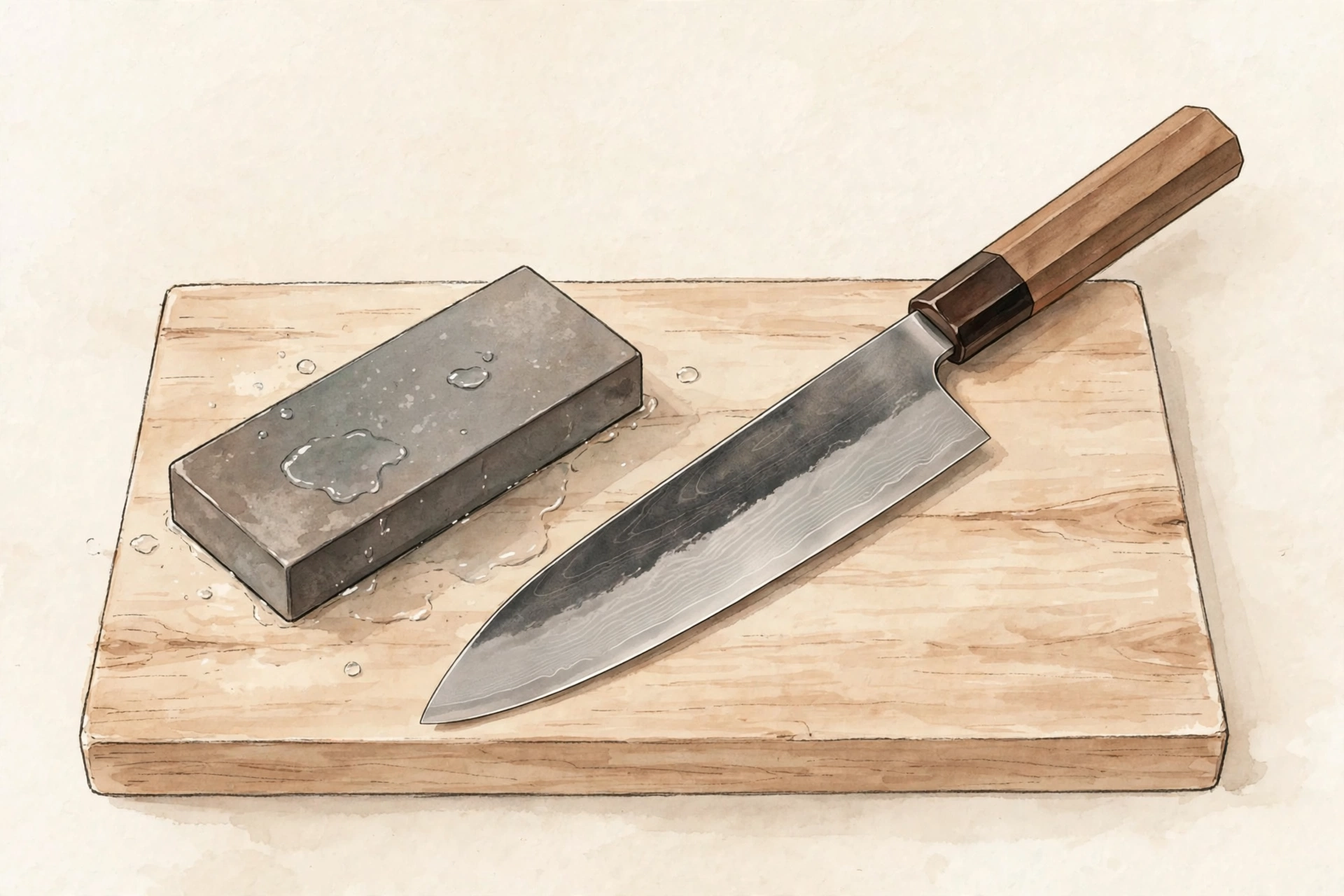
Buy one knife. Not a set, not five shapes, one.
Almost every first-time buyer of a Japanese knife freezes at the same place: hundreds of blades with unfamiliar names — gyuto, santoku, nakiri, aogami — at prices from $50 to $500, and no way to tell what the extra money buys. This guide cuts that down to three knives, one whetstone, and a simple rule for choosing between them.
It is written from Japan, using makers' and specialist retailers' published specifications, and the actual price structure you see in Tokyo's kitchen district. Where sources disagree on a price or a weight, this guide gives the range and says so — knife listings genuinely do vary that much.
Disclosure: this article contains affiliate links. If you buy through them, I may earn a commission at no extra cost to you. Prices were checked in November 2026 and change — check the store page before you buy.
The 30-second answer
- Shape first: if you can only own one, buy a 210mm gyuto. Buy a 165–170mm santoku instead only if your kitchen and board are small, or you almost never cut large meat.
- Default pick: Tojiro DP (Classic) Gyuto 210mm — VG-10 stainless, about $85–139 in the US. It is the knife knife communities have pointed first-timers to for years, for good reason.
- Buy-once pick: MAC MTH-80 — about $145–195. Wirecutter's top chef's-knife pick since 2013. Less "Japanese-feeling," more forgiving, superb cutter.
- Not yet: Takamura Migaki R2 — about $180–230 and often sold out. It is the sharpest knife here and the easiest to chip. It is a brilliant second knife.
- Budget for the stone at the same time: one #1000 whetstone (King KDS #1000/#6000, about $40–55). A Japanese knife you cannot sharpen is a dull knife within a year.
If you only remember one thing: stainless, 210mm, one #1000 stone, no dishwasher, ever.
Gyuto or santoku? The only shape question that matters
- Gyuto (牛刀, "beef sword"): 210–240mm, pointed tip, some curve to the edge. Rocks, glides, and does fine tip work. The all-rounder, and the default if you are undecided.
- Santoku (三徳, "three virtues"): 165–180mm, flatter edge, rounded tip. Push-cuts and chops vegetables beautifully, easier in a small kitchen, gentler learning curve — but short for large meat and big melons, and weak at tip work.
- Nakiri: a vegetable specialist with no tip. Excellent at its one job. Not a first knife.
In Japan, the santoku is the home-kitchen standard and the gyuto is the professional's default. Neither answer is wrong — but if this is your only knife and you cook meat as well as vegetables, the 210mm gyuto covers more of your week.
The three knives, honestly compared
| Tojiro DP / Classic F-808 | MAC MTH-80 | Takamura Migaki R2 | |
|---|---|---|---|
| Type | Gyuto 210mm | Chef's knife 200mm (8") | Gyuto 210mm |
| Steel | VG-10 core, stainless-clad (san mai) | MAC proprietary high-carbon molybdenum stainless | SG2 / R2 powdered stainless, san mai |
| Hardness | ~60 HRC | ~59–61 HRC | ~62–64 HRC |
| Weight | ~187–204g (sources vary) | ~181–193g (6.5 oz listed) | ~150–155g |
| Handle | Western, micarta/pakkawood, bolster | Western, pakkawood, small bolster | Western, red pakkawood |
| US price range* | ~$85–139 | ~$145–195 | ~$180–230, often sold out |
| Character | The default answer | The forgiving workhorse | The laser |
| Best for | First Japanese knife, sensible money | Buy once, cook daily, low drama | Experienced hands that already sharpen |
*Ranges, not live quotes. Tojiro alone was listed at ~$85 by one Japan guide, $119 by one importer and $139 by ChefKnivesToGo / Cutlery and More in November 2026 — same knife, different channel. Always check the listing on the day.
1. Tojiro DP Gyuto 210mm — the default answer
Tojiro, from Tsubame-Sanjo in Niigata, is the knife r/chefknives and the specialist forums point first-timers to so consistently that it has become the community's canned answer — and canned answers in knife forums are earned. VG-10 at around 60 HRC takes a genuinely fine edge, holds it far longer than a German knife at 56–58 HRC, and the stainless cladding means it will not rust while you are learning. The Western handle needs no adjustment if you are coming from a European knife.
Its flaws are honest ones: the factory edge can be uneven, the spine and choil are not as comfortably finished as on pricier knives, and it is not beautiful. None of that stops it cutting. At this price, your inevitable first small chip is a lesson, not a disaster.
Buy it if: this is your first Japanese knife and you want professional sharpness for under about $140. Product link — to be added
2. MAC MTH-80 — the buy-once, low-drama pick
The MAC looks like a Western chef's knife that went to Japan and came back thinner. Made in Seki, around 59–61 HRC, with a dimpled blade face that helps food release, it has been Wirecutter's top chef's-knife pick since 2013, and independent lab testing (TechGearLab) gave it the highest cutting-performance score in its field.
It is a little less hard and a little less thin than the Takamura, and that is exactly why it suits a first buyer who cooks every day: it tolerates the small technique sins — a slight twist prising garlic, a harder board — that would chip a harder, thinner edge. Two caveats from the testers: the handle runs short for very large hands, and at $145–195 (MAC's own list is $195) you are paying for performance, not looks. The handle is plain black pakkawood and it does not pretend otherwise.
Buy it if: you want one knife for a decade, you cook most nights, and you do not want to baby it. Product link — to be added
3. Takamura Migaki R2 Gyuto 210mm — the laser you grow into
Takamura Hamono is a small family forge in Echizen, Fukui. The Migaki R2 is famously thin behind the edge, very light at around 150g, and made from SG2 powdered steel at 62–64 HRC — harder than either knife above, so it gets sharper and stays sharp longer. Reviewers who test many Takamuras rate the R2 Migaki 210mm as the line's best overall, and describe cutting an onion with "unusually little resistance."
Now the part the sales pages soften: that thin, hard edge chips if you lever, twist, or hit bone. It wants a whetstone, a decent board, and a cook who no longer scrapes chopped food sideways off the board with the edge. If that is already you, it is the best knife on this page. If it is not you yet, buy the Tojiro or the MAC now and the Takamura in a year — you will enjoy it twice as much and chip it half as often. It is also frequently sold out at specialist retailers (€197–225 in Europe in November 2026), so expect to join a restock list rather than impulse-buy it.
Buy it if: you already sharpen on a stone and your technique is gentle. Otherwise, bookmark it. Product link — to be added
Steel, in 60 seconds (so the spec sheets stop scaring you)
- VG-10 (Tojiro): stainless, ~60 HRC. The sensible middle — sharp, rust-proof, sharpenable at home.
- MAC's proprietary steel: stainless, ~59–61 HRC. Tuned for toughness and easy maintenance over bragging rights.
- SG2 / R2 (Takamura): powdered stainless, ~62–64 HRC. The longest edge life here, the slowest to sharpen, the least forgiving of abuse.
- Carbon steel (Shirogami / Aogami): takes the keenest edge of all — and rusts if left wet, reacts with acidic food, and must never see a dishwasher. Beautiful, rewarding, and the wrong starting point for most first buyers. Start stainless. You can go carbon for knife number two.
Hardness is a trade, not a score: harder holds an edge longer and chips more easily. Anyone who sells you "higher HRC = better" without the second half is selling.
The stone is not an accessory. Budget for it now.
The most common beginner mistake is buying a five-stone progression and never finishing learning the first one. Buy one #1000 stone and learn it:
- King KDS #1000/#6000 combination — about $40–55. The classic starter. Soft, forgiving, gives obvious feedback and slurry so you can see what you are doing. Soak before use. Made by Matsunaga in Japan.
- Shapton Kuromaku (Pro) #1000 — about $55–75. Splash-and-go, no soaking, harder and faster, stays flat longer. Buy this instead if you know a stone that needs soaking will simply not get used.
A flattening plate can come later. A pull-through sharpener should not come at all — it will tear up a thin Japanese edge.
What prices in Japan actually tell you (read this before you plan a "knife trip")
Tokyo's Kappabashi street — 800 metres, about 170 restaurant-supply shops between Ueno and Asakusa — is where guides send you, and the usual claim is "30–50% cheaper than overseas." That is true for many knives: local guides put a very good stainless gyuto or santoku at about ¥10,000 in Kappabashi and a professional one at about ¥30,000, and a santoku that sells for $80–100 abroad often sits at ¥6,000–9,000 in Tokyo.
But here is the honest correction you will not get from most buying guides: the famous mass-market brands — Tojiro, MAC, Shun — are often priced similarly in Japan to online overseas. The real savings, and the real reason to go, are the regional makers from Sakai, Seki and Echizen who sell through physical shops in Japan and barely appear on Amazon at all. Go to Kappabashi to hold twenty knives and find the one that fits your hand — that is worth more than the discount.
Practical rules if you do buy in Japan: - Checked luggage only. A knife in carry-on will be confiscated. No exceptions, no story makes it OK. - Tax-free changed on 1 November 2026. You now pay the full tax-included price in the shop and claim the consumption tax back at the airport (per Kappabashi guides published November 2026 — confirm the current procedure before you travel). Bring your physical passport, not a photo. - Weekday mornings are best. Most Kappabashi shops open around 10:00 and close 17:00–18:00; the big knife shops (Tsubaya, Kama-Asa) are among the exceptions that open on Sundays.
If you are not travelling, none of this blocks you: all three knives above are sold by US/EU specialist retailers and Amazon, and buying locally gets you a warranty and an easy return if the handle does not fit your hand — which is worth real money on a first knife.
Care rules that decide whether it lasts a month or a decade
- Hand wash, dry immediately. No dishwasher — heat, detergent and rattling against other steel will wreck the edge and the handle.
- No bones, no frozen food, no prising lids, no twisting in a squash. Use your old German knife for the abusive jobs; keep it for exactly that.
- Wood or soft plastic board. Glass and stone boards are edge-killers.
- Store it on a magnetic strip, in a saya, or in its box — never loose in a drawer.
- Sharpen on the #1000 stone when tomatoes start slipping on their skin. Do not wait until it is truly dull; maintaining an edge is five minutes, resurrecting one is an afternoon.
The short version
- Most first buyers: Tojiro DP Gyuto 210mm + King KDS #1000/#6000. About $125–195 all-in, and you are properly equipped.
- Buy-once buyers: MAC MTH-80 + Shapton Kuromaku #1000. More money, less drama, a decade of daily use.
- Already sharpen, already gentle: Takamura Migaki R2. Just know why it is not the default recommendation — and enjoy being the exception.